
How to choose a reputation management company: 10 questions, removal claims decoded, and how to check their own reviews
Removal promises, legal letters, “contacts at Google”: what to ask a reputation company, what Google and the FTC say, and a five-minute check of its own Google profile, tested on 17 agencies in four cities.
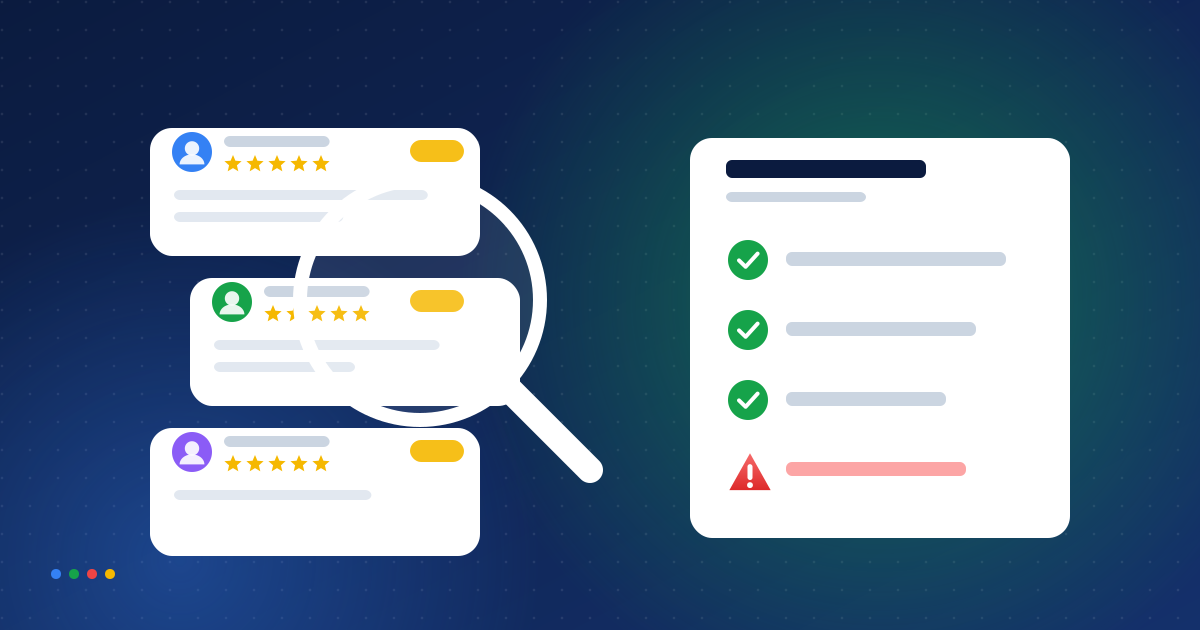
Choose a reputation management company on what you can check, not on what it promises. Ask how it decides which reviews to report and under which Google rule, whether it ever contacts reviewers or uses legal letters, and what it refuses to do. Then check its own Google profile: are the reviews recent, spread over time, written in real words, and is the firm really in your city? In our check of 17 agencies that Google listed first in four cities, 15 were rated 4.8 stars or higher, so the stars tell you almost nothing; dates, text and references do.
15 of 17 reputation agencies that Google listed first in Washington DC, Zürich, Dubai and Kuala Lumpur were rated 4.8 stars or higher.
In 10 of the 17, at least two of the five newest reviews were posted within three days: a reason to read them closely, not proof of anything.
Only 1 of the 5 agencies listed for “reputation management company Washington DC” had an address in DC.
In this article (8)
- 1.Why choosing is hard: everyone looks the same
- 2.Removal promises, decoded
- 3.Legal threats and suppression: where the line is
- 4.10 questions to ask a reputation management company
- 5.Check the company’s own Google reviews in five minutes
- 6.References: how to check them properly
- 7.How we answer these questions at Rating Matters
- 8.Method and limits
Why choosing is hard: everyone looks the same
Reputation management companies sell trust, so their own profiles look spotless. Most promise “more 5-star reviews” and “bad reviews handled”. The differences are in how they do it, and some methods put your Google profile, and in the US your business, at risk. This guide is the reputation-specific part. For general agency checks (contracts, reporting, notice periods) use our checklist for choosing a digital marketing agency; for what such a company does and costs, see reputation management company: what it does, what it costs and red flags.
Companies pay up to CHF 117 for one click from someone comparing reputation firms. That money comes back through your fee, so it is worth ten minutes of checking before you sign.
Removal promises, decoded
The biggest risk in this market is what a company says about negative reviews. Google’s rule is simple, and every honest answer follows from it:
“You can report any review, but only those that violate Google policies are eligible for removal.”
| What they say | What it really means | Ask them |
|---|---|---|
| “We remove negative reviews.” | Only reviews that break Google’s rules can be removed, and Google decides. A genuine bad review stays. | “Which of my reviews break which rule?” Expect an answer per review, not a promise. |
| “Pay only when the review is gone.” | A success fee rewards whatever works, including pressure on reviewers or mass flagging. | “What exactly do you do to get a review removed, step by step?” |
| “We have a contact at Google.” / “We are Google-approved for removals.” | Google’s help pages describe one route for everyone: report the review, Google evaluates it. Its policy for agencies forbids pretending to be Google or directly affiliated with it. | “Show me where Google says that on its own help pages.” |
| “98 % removal rate.” | A rate means nothing without the base: how many reviews they reported, and of which kind. | “Of the reviews you reported last quarter, how many did Google remove, and how many stayed?” |
| “We push the bad results down.” | Often called suppression: publishing other content so a page or review is seen less. It can mean real articles and profiles, or fake sites and fake reviews. | “What will you publish, where, and under whose name?” |
| “Our lawyers will write to the reviewer.” | Legal letters are for real legal claims. Threats without a basis can break the FTC rule in the US. | “On what legal basis, and does a lawyer in my country review every letter?” |
Google also says: “Do not report a review just because you disagree with it or dislike it.” and “Google doesn't get involved in conflict between businesses and customers.” Review evaluation “typically takes several days”, and if a flagged review does not qualify, you can “submit a one-time appeal.” How to do this yourself is in how to remove a Google review.
From Google’s third-party policy for agencies: “Don't make false, misleading, or unrealistic claims.” It lists “Guarantees top placement on Google.” as one, and forbids agencies to “Misrepresent as Google, or as a party directly affiliated with Google, through misleading organization account names.”
Legal threats and suppression: where the line is
Some companies offer to “handle” reviewers with letters, calls or public replies that accuse them. In the US, the FTC’s Consumer Reviews and Testimonials Rule has been in effect since 21 October 2024. It bans suppressing reviews through unfounded or groundless legal threats, physical threats or intimidation, and through false public accusations against the reviewer. The FTC’s own Q&A says:
- Threats.“You can threaten a legal action if you have a legitimate basis for doing so.” Without one, it can be a violation.
- Intimidation.“Your response also shouldn't use physical threats or intimidation to get the review (or a portion of it) removed or changed.”
- The agency is liable too.Asked whether reputation management companies are covered, the FTC answers that they are “not immune from liability under the rule.”
- Real consequences.On 22 December 2025 the FTC announced warning letters to 10 companies about possible violations, noting civil penalties of “up to $53,088 per violation.”
“These entities are not immune from liability under the rule.”
If a review is unlawful, for example defamatory under your local law, the route is a lawyer and Google’s legal form, not pressure. Google’s legal help says: “If you see content on a Google product that you believe violates the law or your rights, let us know.” and “We'll review the material and consider blocking, limiting, or removing access to it.” A reputation company may help you collect the facts; the legal judgement belongs to a lawyer.
Fake content is out everywhere: Google’s policy does not allow content posted on a competitor’s place “to undermine that business' or product's reputation”, and for rule breakers Google says “we may take actions that will range from suspending the account privileges to account termination.” A company that writes reviews about your competitors, or fake praise for you, puts your profile at risk.
10 questions to ask a reputation management company
Ask them in the first meeting and write down the answers. A good company answers in specifics and is not offended.
| Question | A good answer sounds like | Be careful if |
|---|---|---|
| 1. Look at three of my negative reviews: which would you report, under which Google rule? | “This one is off-topic or a conflict of interest, we would report it under that policy. These two are genuine, we would reply to them.” | They say all three can go. |
| 2. Of the reviews you reported last quarter, how many did Google remove? | A real count, with “most genuine reviews stay”. | Only a percentage, or “almost all”. |
| 3. Do you ever contact reviewers? How? | “Only through your public reply, in your name, after you approve it.” | Calls, messages or “we find out who wrote it”. |
| 4. Do you send legal letters? Who decides? | “No. If you think a review is unlawful, talk to a lawyer; we help gather the facts.” | Letters are part of the package. |
| 5. Do you publish anything under other names, or create sites or profiles? | “Only content in your name, on channels you own or real directories.” | Networks of sites, “guest reviews”, new profiles. |
| 6. Can I call two current clients in my industry and city? | Names and numbers, with the clients’ permission. | Only logos, or testimonials you cannot verify. |
| 7. Can I see a client’s Google profile before and after, with their permission? | A public profile you can open yourself and compare. | Screenshots only. |
| 8. Who does the work, and where are they based? | Named people or a team, a real location, clear languages. | No one can tell you. |
| 9. What do I pay if a review stays? | A fixed monthly price for the work, written down. | Only success fees, or fees per removal. |
| 10. What will you not do? | “No bought or written reviews, no rewards for reviews, no asking only happy customers, no removal or ranking guarantees.” | They cannot name anything. |
Question 10 matters most. Google’s policy lists what is not allowed: incentives “in exchange for posting any review or revision or removal of a negative review”, and asking in a way that would “selectively solicit positive reviews from customers”. A company that cannot name its own limits will not respect Google’s.
Check the company’s own Google reviews in five minutes
A reputation company’s own profile is its business card. We read the Google profiles of the reputation management agencies that Google listed first for four cities on 28 November 2026:
| City searched | Agencies | Median reviews | Newest review ≤ 30 days | Two of newest five within 3 days | Address in the city |
|---|---|---|---|---|---|
| Washington DC | 5 | 75 | 4 of 5 | 1 of 5 | 1 of 5 (others: MD, VA, NY, FL) |
| Dubai | 5 | 50 | 0 of 5 | 3 of 5 | 5 of 5 |
| Kuala Lumpur | 5 | 65 | 0 of 5 | 5 of 5 | 5 of 5 |
| Zürich | 2 | – | 1 of 2 | 1 of 2 | 2 of 2 |
| All | 17 | 65 | 5 of 17 | 10 of 17 | 13 of 17 |
What stands out: the stars are almost the same everywhere, so they do not help you choose. Three things differ a lot. First, how recent the reviews are: in Dubai and Kuala Lumpur none of the agencies had a review from the last month. Second, how they arrive: in Kuala Lumpur every agency had two or more of its five newest reviews within three days, and two had all five within one week, more than four months ago, with nothing since. Third, where the firm is: four of five DC results had their address in another state.
- Sort by newestOpen the profile on Google Maps, reviews, sort by newest. When was the last review? A firm that sells review collection should collect its own.
- Look at the datesSteady over months, or several on one day and then silence?
- Read the textReal reviews name a problem, a person or a result. Stars without words, or very similar wording, tell you little. In our sample, 17 of the 77 newest reviews had fewer than 10 words or no text.
- Read the bad ones and the repliesHow does the firm answer criticism of itself? That is how it will answer for you.
- Check the addressIs the firm in your city or country, or does it only rank there? Both can work, but you should know.
A small number of reviews is not a red flag on its own. Agencies have far fewer customers than a plumber or a salon: the typical agency here had 65 reviews, while the typical hair salon we checked around Washington DC had 320 (DC study). Fresh, specific reviews from real clients count more than a big total.
References: how to check them properly
- Ask for two clients like you.Same industry, same city or country, working with the company for at least six months.
- Open their Google profile yourself.Note the review count and the date of the newest review today. Ask the client what it was when they started.
- Ask the client who owns the profile.Google requires that “all end customers must retain ownership or co-ownership of their Business Profile at all times.” If the agency owns it, that is a problem.
- Ask how negative reviews were handled.Were they replied to, reported, or did something happen the client did not understand?
- Ask what the client would change.Every honest reference has one answer to this.
- They name which reviews can be reported and why, and say the rest stay.
- You approve every reply and every report before it goes out.
- You keep ownership of your Google profile, links and cards.
- The price is fixed and written, and references check out.
- They promise removal of genuine reviews or a top ranking.
- They mention contacts at Google or legal letters as a routine tool.
- They offer reviews, rewards for reviews, or content under other names.
- Their own profile and references do not match what they say.
How we answer these questions at Rating Matters
We are a reputation management and digital marketing agency headquartered in Zürich, with team hubs in Washington DC, Dubai and Kuala Lumpur. Our answers to the questions above: we report only reviews that break Google’s rules, Google decides, and genuine negative reviews stay and get a calm reply. We do not buy or write reviews, we do not contact reviewers outside a public reply you approve, and we do not send legal letters. Your Google profile stays yours. You get a written price before anything starts and there is no minimum term. Check our own Google profile with the five-minute test above. Our service for removing reviews that break Google’s rules and the weekly work of a review management service are explained on their own pages.
Method and limits
- What we read.Google Places text search for “reputation management company Washington DC”, “reputation management agency Zürich”, “reputation management company Dubai” and “reputation management company Kuala Lumpur”; the first five agency results each; star rating, total reviews, and the five newest reviews (date, stars, length of text).
- When.28 November 2026. Ages of reviews are counted from that date.
- Sample.17 agencies. Zürich returned three results; our own profile was left out. No result appeared twice.
- What it is not.Not a ranking of companies and not a test of whether any review is genuine. A text search is not what each person sees on the map. Word counts are approximate.
- No names.We publish only totals and medians, never the agencies.
Common questions
Can a reputation management company remove Google reviews?
It can report reviews to Google, like anyone can. Google says only reviews that violate its policies are eligible for removal, and Google decides. A company that promises to remove genuine negative reviews is promising something it does not control.
Are reputation management companies legit?
Many are, and the work they do (asking customers for reviews, replying, reporting policy-breaking reviews, monthly reports) is useful. Check how they handle removals, whether they contact reviewers or use legal threats, and whether their own reviews and references hold up. In the US, the FTC says reputation management companies are “not immune from liability” under its consumer review rule.
Is it legal to threaten a reviewer with a lawsuit?
In the US, the FTC rule bans suppressing reviews through unfounded or groundless legal threats or intimidation; the FTC says you can threaten a legal action if you have a legitimate basis for doing so. Other countries have their own rules. Ask a lawyer in your country before any letter is sent.
What is review suppression?
Keeping reviews from being seen or posted, for example by threats, by intimidating reviewers, or by hiding negative reviews on your own site. The FTC rule in the US prohibits several forms of it. Pushing down search results with new content is a different practice: fine with real content in your name, risky with fake sites or fake reviews.
How can I tell if an agency's own reviews are real?
Sort its Google reviews by newest and look at dates, text and replies. Steady reviews over months that name real work are a good sign. Bursts on one day, stars without words and silence since then are a reason to ask for references you can call. In our sample, 10 of 17 agencies had at least two of their five newest reviews within three days.
How much does a reputation management company cost?
Prices vary by country and scope, usually as a monthly fee. Compare written offers for the same work. What drives cost and which pricing models exist is in our guide to reputation management companies; avoid fees per removed review.
- Google Business Profile Help: Report inappropriate reviews
- Google Maps user-generated content policy: Prohibited & restricted content
- Google Business Profile Help: Third-party policy for Business Profile
- Google Legal Help: Report content for legal reasons
- FTC: Consumer Reviews and Testimonials Rule, Questions and Answers
- FTC press release, 22 December 2025: FTC warns 10 companies about possible violations of the consumer review rule
- Google Ads: Keyword Planner (search volumes and top-of-page bid ranges)
Ask us the 10 questions
Send us your business name or Google Maps link and the questions above. A real person looks at your reviews, tells you which ones could be reported under Google’s rules and which ones need a reply, and sends you a written price.
Keep reading
All articles Reviews & ReputationOriginal data7 min read
How many Google reviews does a business in Washington DC need? 56 businesses in DC, Arlington and Bethesda
We read the Google profiles of 56 plumbers, HVAC companies, dentists and hair salons around DC: how many reviews they have, how fresh they are, and why home-service firms compete across the whole DMV.
Read the guide Reviews & ReputationOriginal data10 min read
Review management service: how it works for a local business, and what to check before you pay
Asking, replying, watching, reporting: what a review service does every week, what Google forbids, how to read the monthly report, and what 15 DC-area dentists' newest reviews show.
Read the guide Reviews & ReputationOriginal data8 min read
How many Google reviews should your business have? 400 Zürich businesses, and one restaurant far above them
We counted the Google reviews of 400 Zürich businesses. Then we looked at one Niederdorf restaurant with ten times the median: 42% more customer actions on Google and 10% more revenue, in the year its groups cancelled.
Read the guide